





 購物車 / 產生報價單



取消
商品圖片僅供參考,選購時請再留意商品規格
商品圖片僅供參考,選購時請再留意商品規格
商品圖片僅供參考,選購時請再留意商品規格
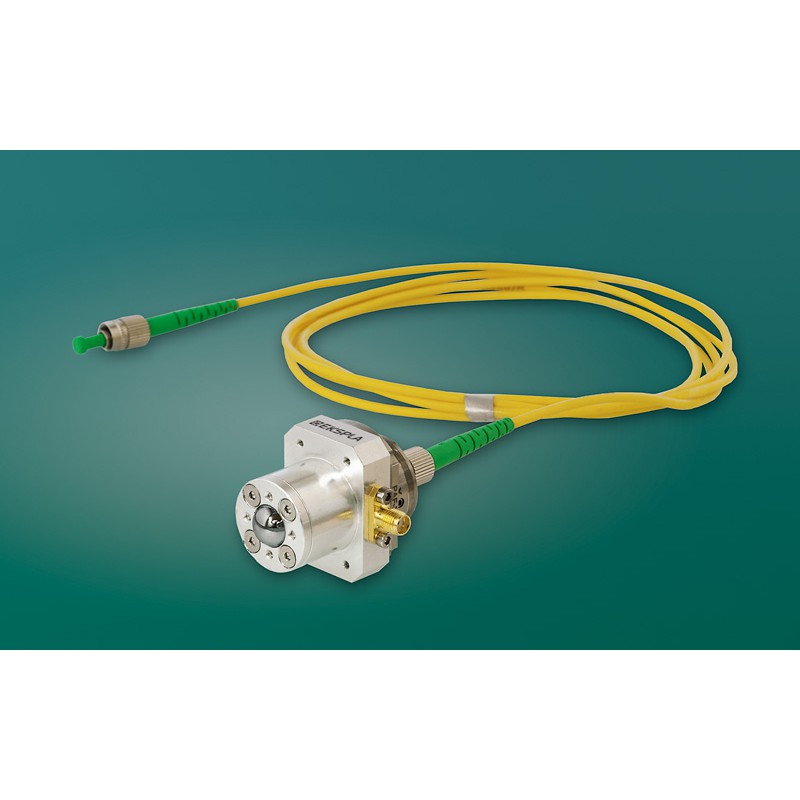
EKSPLA 光纖太赫茲發射器和探測器
商品包含多種型號及規格,請點選「立即選購規格」挑選
💡 重要通知:
因中東戰爭造成原物料波動影響,若訂單成立後進貨成本發生重大異動,我們將主動聯繫您協商處理。造成不便,敬請見諒。

月結報帳 / 信用卡 / 銀行轉帳

宅配快速到貨,滿 NT$ 999 元即享免運!
選購型號
商品介紹
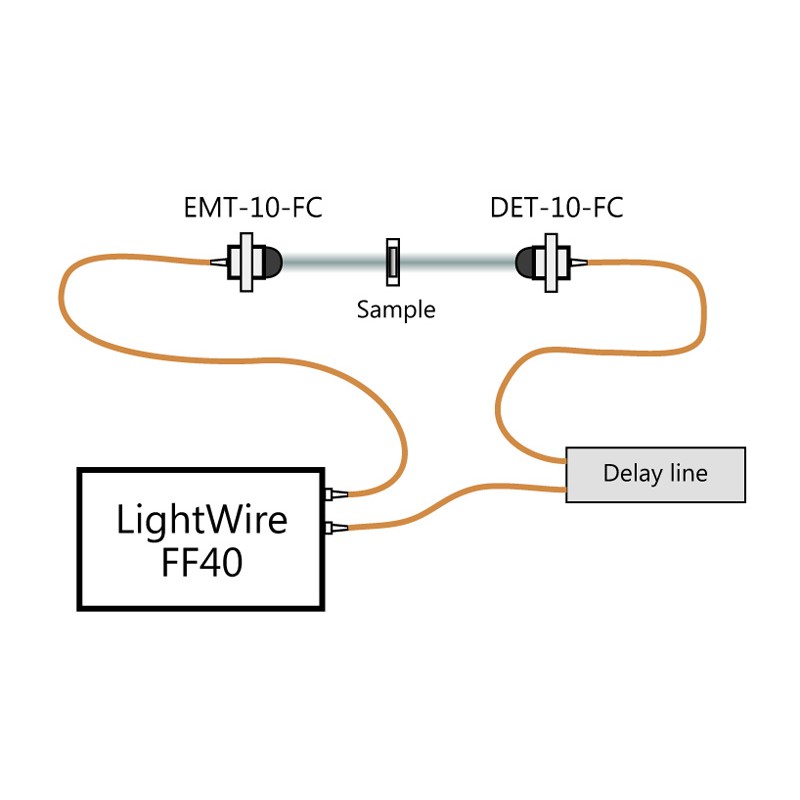
Fiber-coupled THz emitters and detectors offered by EKSPLA are designed for broadband operation and can be used in standard timedomain (THz-TDS) setup.
Unique GaBiAs material used in photoconductive antennas (PCA) features excellent sensitivity for wavelengths up to approx. 1060 nm and electron lifetime shorter than 1 ps. As a result ultra short half-cycle THz pulses with broad spectra up to 5 THz can be generated and detected. Pump beam fiber delivery eliminates timeconsuming adjustments and ensures maximum flexibility of experiment. As an example, this feature allows fast and convenient switching between different geometries: transmission, reflection, etc. THz emitters and detectors are mounted into compact housing compatible with standard 1” optical holders. Performance of each device is checked and technical passport, including testing report, is provided for customer.
Integrated silicon lens
THz emitters and detectors are supplied with integrated hyperhemispherical lenses, made from high-resistivity silicon, attached to PCA to increase the radiation efficiency of THz waves into free space. EKSPLA offers two standard types of these lenses: for collimated or diverging THz beam output. Advantage of collimated THz beam output is simple setup, because no additional optical components between THz emitter and detector are required for experiment. However, this design features bigger aberrations of THz beam, which affects focusing. In second case design of lens assumes positioning of the PCA in aplanatic point, which significantly reduces aberrations. As a result nearly diffraction limited spot of THz beam can be achieved.
Photoconductive antenna (PCA )
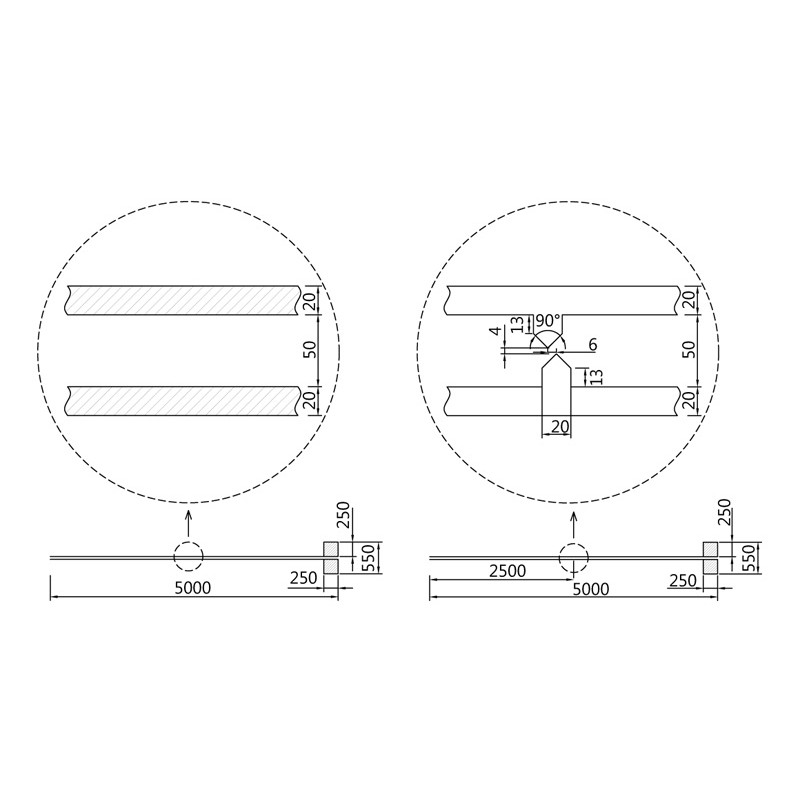
Photoconductive antennas are particularly designed for THz emitter or THz detector. The substrate of GaAs contains messa-etched epitaxial active layer of GaBiAs in order to achieve high dark resistance. High photosensitivity of the material allows use of low average power optical pulses for excitation. On its surface a coplanar Hertzian type dipole antenna structure is formed using AuGeNi metallization.
The gap between metallic contacts is similar to laser spot diameter in detector case and larger – in emitter case. Photoconductive chip is mounted on PCB and placed inside metallic housing of device. SMA sockets on back side of the housing are used to connect DC or AC bias to THz emitter or lock-in amplifier input to THz detector.
Fiber delivery
Each fiber-coupled THz emitter and detector is delivered with specially design optical fiber. Standard configuration requires pre-chirped pulse with 0.5-2 ps duration on fiber input. Typically such pulse parameters are available directly from fiber lasers before compressor stage. In this case pulse is compressed while propagating through optical fiber with negative dispersion. Another solution can be applied for femtosecond pulses – near zero dispersion optical fiber. In such fiber femtosecond pulse keeps its form and pulse duration doesn’t differ much on input and output of fiber. In both cases it works only for particular wavelength, so it should be specified while ordering. Laser radiation is delivered through FC/PCA fiber connector. It is focused onto PCA using lenses fixed inside the housing of THz emitter and THz detector.
FEATURE
Based on unique GaBiAs photoconductive material
Optimized for wavelengths around 1060 nm
Pump pulse fiber delivery
Technical passport and test report included
RELATED APPLICATIONS
Time-resolved broadband THz spectroscopy
Optical pump-THz probe spectroscopy
Suitable for all-in-fiber system solution.
以上圖片及相關資訊由 EKSPLA提供。
若有現場安裝、說明或特殊配送需求,歡迎事前與科研市集聯繫。部分商品因供應條件限制,可能無法提供相關服務,敬請見諒。
商品資訊

商品品牌