





 購物車 / 產生報價單



商品圖片僅供參考,選購時請再留意商品規格
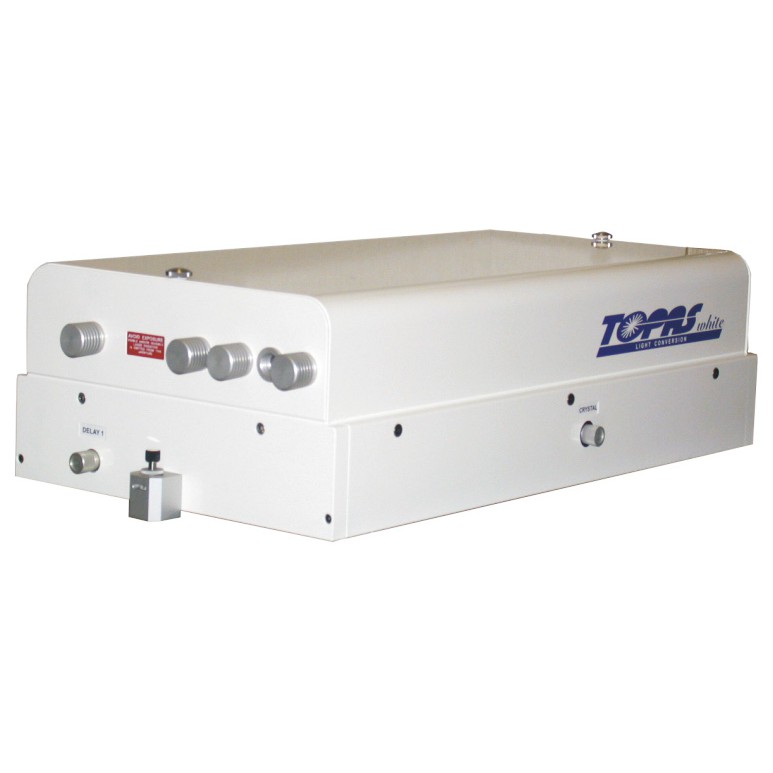
LIGHT CONVERSION TOPAS-WHITE系列脈衝輸出調節器
商品包含多種型號及規格,請點選「立即選購規格」挑選

月結報帳 / 信用卡 / 銀行轉帳

宅配快速到貨,滿 NT$ 999 元即享免運!
選購型號
商品介紹
Basics of operation A non – collinear pumping scheme of an OPA is used when the collinear approach for the OPA reaches its limits in respect to broad spectral bandwidth and / or extremely short pulses (< 20 fs). The basic principle of operation of NOPA relies on parametric amplification of chirped signal produced by supercontinuum generation in a transparent medium possessing third order nonlinearity. The non-collinear geometry is used due to broad amplification bandwidth in the visible spectral range. Design and performance The main problem in the “classical” NOPA approach is associated with non-collinear geometry and limited applicable pump energy. Typical signal pulse energy is a few microjoules. In the "TOPAS-white" developed by Light Conversion, the output energy is enhanced by using the pump pulse with an appropriate front tilt. The pump pulse tilt is achieved by combination of dispersive optics and a telescope. Another problem of the “classical” NOPA approach is a complex issue of dispersion matching over broad wavelength range, which is necessary for generation of near- transform limited sub-30 fs pulses. This problem is usually solved either by optimizing the pulse compressor for limited wavelength range, or by use of complex adaptive systems that usually introduce significant loss for the output pulse. The "TOPAS-white" offers significant improvement regarding above problems. The device is a two-stage non-collinear parametric amplifier of white-light continuum. The way of operation is as follows (see schematic). Optical layout of "TOPAS-white" A small fraction of the incoming 800 nm pulse is used to produce white-light continuum in a sapphire plate. The white light beam is collimated using chromatic aberration free, low astigmatism collimator. Then the pulse is sent into a double pass negative dispersion pulse phase shaper consisting of a diffraction grating, a spherical mirror, a folding mirror and a phase mask. Dispersion of this pulse shaper is calculated in order to achieve an adapted chirp of the seed pulse such that: first, the desired bandwidth fits under the pump pulse; secondly, the amplified signal pulse is compressed to the transform limit using material dispersion of fused silica or other material. In addition, the pulse shaper allows controlling the pulse spectrum: by placing a mask in front of the folding mirror one can clip off unwanted spectral components such as residual 800 nm, or narrow the bandwidth. After passing the stretcher the seed pulse is fed into the preamplifier stage. The maximum bandwidth than can be amplified is from ~500 nm to 750 nm. In the power-amplifier stage, the signal beam is overlapped within the same non-linear crystal with the main pump beam. After the power-amplifier stage, the beam is collimated using a mirror telescope and passes the adjustable compressor made of two AR coated fused silica wedges. "TOPAS-white" tuning range can be extended into UV by using optional signal second harmonic generator. Computer controlled tuning "TOPAS-white" is equipped with computer controllable stepping motor stages, which allow automatic tuning of the output wavelength. During wavelength tuning, the computer controls crystal angle, the two delays, compressor setting, and the optional second harmonic crystal angle. Standard "WinTOPAS" software is used to drive "TOPAS-white". The program is written in C++ and supports interfacing with master routine in LabView. FEATURE Pulse Duration Down to 10 Femtoseconds High Energy Visible Output Wavelength Tuning Computer Controlled Tuning Range up to 250-375, 425-750, 850-1000 nm Pulse Duration and Bandwidth Control Built in Pulse Compressor Compact and Stable Design High Output Stability Repetition rate: <20 kHz Maximum power : 10W
以上圖片及相關資訊由 LIGHT CONVERSION提供。
若有現場安裝、說明或特殊配送需求,歡迎事前與科研市集聯繫。部分商品因供應條件限制,可能無法提供相關服務,敬請見諒。